Search results for income tax e-filing in India 2026 in India in India explained
- incometax.gov.in › iec › foportalEN
Income Tax Department: Home
# [](https://www.incometax.gov.in/iec/foportal/) 1800 419 0025 08:00 hrs - 20:00 hrs (Monday to Friday) 07:00 hrs - 23:00 hrs (All Days) 1800 103 4215 09:30 hrs - 18:00 hrs (Monday to Friday) [](https://www.incometax.gov.in/iec/foportal/#/) [](https://www.incometax.gov.in/iec/foportal/#/) Form 1 under the “Foreign Assets of Small Taxpayers Disclosure Scheme” is now available for filing. 2. ITR-1, ITR-2, ITR-3, ITR-4, ITR-5, ITR-6 and ITR-7 for AY 2026-27 are available for filing through both online and offline utilities. Filing of TDS/TCS Correction Statements pertaining to Tax Year 2026-27 will be enabled shortly. 4. DFC may be contacted through the e-mail id: [taxdemand@cpc.incometax.gov.in](mailto:taxdemand@cpc.incometax.gov.in) or on the toll-free number - 1800 309 0131 or chargeable no. Excel utilities for filing Updated return for ITR-1 to 7 for AY 2022-23 as per Finance Act, 2026 are available for filing ! ❚❚ # What's New The Income Tax Department has enabled the **Foreign Assets of Small Taxpayers Disclosure Scheme, 2026 (FADS 2026)** on the e-Filing Portal. Under the scheme, eligible taxpayers can furnish the prescribed declaration form online through the e-Filing Portal. # Quick Links [\ \ \ \ e-Verify Return](https://eportal.incometax.gov.in/iec/foservices/#/pre-login/eVerifyReturn-bl) [\ \ \ \ Instant E-PAN](https://eportal.incometax.gov.in/iec/foservices/#/pre-login/instant-e-pan) [\ \ \ \ Authenticate notice/order issued by ITD](https://eportal.incometax.gov.in/iec/foservices/#/pre-login/authenticate-notice-issued-by-itd) [\ \ \ \ Submit Information on Tax Evasion or Benami Property](https://eportal.incometax.gov.in/iec/foservices/#/pre-login/tax-evasion-prelogin) # Latest Updates E-Mail File your ITR for AY 2026-27 E-Mail File your ITR for AY 2026-27
- incometax.gov.in › iec › foportal › helpEN
Income Tax Returns
1 day ago · The provisions relating to filing of return of income are contained in Section 263 of the Income Tax Act, 2025. Section 263 contains the ...
- timesofindia.indiatimes.com › business › india-business › itr-deadline-on-july-31-2026-top-things-nris-should-keep-in-mind-when-filing-tax-returnEN
ITR deadline on July 31, 2026: Top things NRIs should keep in mind ...
July 31, 2026 is the deadline to file income tax returns for salaried taxpayers and pensioners. Income Tax e-Filing portal using the applicable ...
- facebook.com › clearfromcleartax › videos › itr-filing-for-ay-2026-27-is-now-livethe-income-tax-department-has-officially-enEN
ITR Filing for AY 2026-27 is Now LIVE! The Income Tax Department ...
ITR Filing for AY 2026-27 is Now LIVE! The Income Tax Department has officially enabled online filing and Excel utilities for ITR-1 and ...
- fincart.com › blog › itr-filing-2026EN
ITR Filing 2026: Complete Step-by-Step Guide - Fincart
ITR Filing 2026 guide walks you through everything you need to know, including deadlines, documents, the filing process, and how to avoid the ...
- cleartax.inEN
Income Tax Login | Income Tax efiling in India for FY 2025-26 (AY 2026 ...
# India’s Most Trusted Tax Filing Platform ## Frequently Asked Questions You are required to file an [income tax](https://cleartax.in/s/income-tax) return once your annual income exceeds Rs 2.5 lakh. While e-filing your ITR, you should furnish the details of your annual income, claim deductions and credit for TDS deducted by your employer. You can claim an income tax refund by e-filing your income tax return. An e-filing enables you to claim credit for excess TDS paid and a tax refund. You can efile income tax return on your income from salary, house property, capital gains, business & profession and income from other sources.
- incometax.gov.in › iec › foportal › helpEN
Salaried Individuals for AY 2026-27 - Income Tax Department
# [](https://www.incometax.gov.in/iec/foportal/) Salaried Individuals for AY 2026-27 | Income Tax Department ## Returns and Forms Applicable for Salaried Individuals for AY 2026-27 | | | | | | |-|-|-|-|-| | 1. **ITR-1 (SAHAJ) – Applicable only for Individual** | | This return is applicable for a Resident (other than Not Ordinarily Resident) Individual having Total Income from any of the following sources up to ₹ 50 lakh | | | | | | | | | --- | --- | --- | --- | --- | | Salary / Pension | One House Property | Other sources (Interest, Family Pension, Dividend etc.) | Agricultural Income up to ₹ 5,000 | Capital Gain income u/s 112 A (Income Tax Act,1961) up to ₹ 1,25,000 | | | Note: ITR-1 cannot be used by a person who:<br>a) is a Director in a company <br>b) has short term capital gain<br>c) has Long-term capital gain u/s 112A of Income Tax Act,1961 exceeding ₹1,25,000<br>d) has held any unlisted equity shares at any time during the previous year <br>e) has any asset (including financial interest in any entity) located outside India <br>f) has signing authority in any account located outside India <br>g) has income from any source outside India <br>h) is a person in whose case tax has been deducted u/s 194N of Income Tax Act,1961<br>i) is a person in whose case payment or deduction of tax has been deferred on ESOP<br>j) has any brought forward loss or loss to be carried forward under any head of income<br>k) has total income exceeding ₹50 lakhs (excluding LTCG u/s 112A upto ₹1,25,000) | | | | |-|-| | **2. ITR-2 - Applicable for Individual (Not eligible for ITR 1) and HUF** | | This return is applicable for Individual and Hindu Undivided Family (HUF) | | | | | | --- | --- | | Having Income under any head other than Profits and Gains of Business or Profession. | Who is not eligible to file ITR-1 | | | | | | | | |-|-|-|-|-| | **4. ITR-4 (SUGAM) – Applicable for Individual, HUF and Firm (other than LLP)** | | This return is applicable for an Individual or Hindu Undivided Family (HUF), who is Resident other than Not Ordinarily Resident or a Firm (other than LLP) which is a Resident having Total Income under Business or Profession which is computed on a presumptive basis (u/s 44AD / 44ADA / 44AE of Income Tax Act,1961) and income from any of the following sources: | | | | | | | | | --- | --- | --- | --- | --- | | Salary / Pension | One House Property | Other sources (Interest, Family Pension, Dividend etc.) | Agricultural Income up to ₹ 5,000 | Capital Gain income u/s 112 A (Income Tax Act,1961) up to ₹ 1,25,000 | | | **Note 1:**<br>ITR-4 cannot be used by a person who:<br>01. is a Director in a company<br>02. has short term capital gains <br>03. has Long-term capital gain u/s 112A of Income Tax Act,1961 exceeding ₹1,25,000<br>04. has held any unlisted equity shares at any time during the previous year <br>05. has any asset (including financial interest in any entity) located outside India<br>06. has signing authority in any account located outside India <br>07. has income from any source outside India <br>08. is a person in whose case payment or deduction of tax has been deferred on ESOP<br>09. who has any brought forward loss or loss to be carried forward under any head of income<br>10. has total income exceeding ₹50 lakhs (excluding LTCG u/s 112A upto ₹1,25,000)<br>**Note 2:**<br>ITR-4 (Sugam) is not mandatory. It is a simplified return form to be used by an Assessee, at his option, if he is eligible to declare Profits and Gains from Business or Profession on presumptive basis u/s 44AD, 44ADA or 44AE of Income Tax Act,1961. | ## Forms Applicable (As per Income Tax Act,1961): | | | |-|-| | **5. Form 26 AS** | **AIS (Annual information Statement)** | | **Provided by:**<br>Income Tax Department (It is available on e-Filing Portal:<br>Login > e-File > Income Tax Return > View Form 26AS) | **Provided by:**<br>Income Tax Department (It can be accessed after logging on to Income Tax e-Filing portal)<br>Login to e-filing portal > AIS | | **Details provided in the form:**<br>Tax Deducted / Collected at Source. | **Details provided in the form:**<br>- Tax Deducted / Collected at Source<br>- SFT Information<br>- Payment of taxes<br>- Demand / Refund<br>Other information (like Pending/Completed proceedings, GST Information, Information received from foreign government etc.) | #### Tax Slabs for AY 2026-27*** **New Tax Regime Vs Old Tax Regime:** However, the eligible taxpayers have the option to opt out of default tax regime and choose to be taxed under old tax regime. However, in default tax regime, tax rates are lower with very few deductions compared to old tax regime. **Non-business case:** **Business case:** Also, for the purpose of withdrawal of such option i.e. re-entering into default tax regime (New Tax regime) shall also be done by way of furnishing Form No.10-IEA on or before the due date specified u/s 139(1)of the Income Tax Act,1961 for furnishing return of income. However, option to withdraw from the old tax regime and re-enter into default tax regime (New Tax regime) ,is available only in subsequent AY and is available only once in lifetime for eligible taxpayers having income from business and profession. Tax rates for Individual (resident or non-resident) less than 60 years of age anytime during the previous year are as below: | | | | | |-|-|-|-| | **Old Tax Regime** | **New Tax Regime u/s 115BAC of Income Tax Act,1961** | | **Income Tax Slab** | **Income Tax Rate** | **Income Tax Slab** | **Income Tax Rate** | | Up to ₹ 2,50,000 | Nil | Up to ₹ 4,00,000 | Nil | | ₹ 2,50,001 –<br>₹ 5,00,000 | 5% above ₹ 2,50,000 | ₹ 4,00,001 –<br>₹ 8,00,000 | 5% above ₹ 4,00,000 | | ₹ 5,00,001 –<br>₹ 10,00,000 | ₹ 12,500 + 20% above<br>₹ 5,00,000 | ₹ 8,00,001 –<br>₹ 12,00,000 | ₹ 20,000 + 10% above ₹ 8,00,000 | | Above<br>₹ 10,00,000 | ₹ 1,12,500 + 30% above<br>₹ 10,00,000 | ₹ 12,00,001 – ₹ 16,00,000 | ₹ 60,000 + 15% above ₹ 12,00,000 | | | ₹ 16,00,001 - ₹ 20,00,000 | ₹ 1,20,000 + 20% above ₹ 16,00,000 | | | ₹ 20,00,001 - ₹ 24,00,000 | ₹ 2,00,000 + 25% above ₹ 20,00,000 | | | Above ₹ 24,00,000 | ₹ 3,00,000 + 30% above ₹ 24,00,000 | Tax rates for Individual (resident or non-resident), 60 years or more but less than 80 years of age anytime during the previous year are as under: | | | | | |-|-|-|-| | **Old Tax Regime** | **New Tax Regime u/s 115BAC of Income Tax Act,1961** | | **Income Tax Slab** | **Income Tax Rate** | **Income Tax Slab** | **Income Tax Rate** | | ₹ 3,00,001 – <br>₹ 5,00,000 | 5% above ₹ 3,00,000 | ₹ 4,00,001 –<br>₹ 8,00,000 | 5% above ₹ 4,00,000 | | ₹ 5,00,001 – <br>₹ 10,00,000 | ₹ 10,000 + 20% above ₹ 5,00,000 | ₹ 8,00,001 –<br>₹ 12,00,000 | ₹ 20,000 + 10% above <br>₹ 8,00,000 | | Above <br>₹ 10,00,000 | ₹ 1,10,000 + 30% above ₹ 10,00,000 | ₹ 12,00,001 –<br>₹ 16,00,000 | ₹ 60,000 + 15% above<br>₹ 12,00,000 | | | ₹ 16,00,001 –<br>₹ 20,00,000 | ₹ 1,20,000 + 20% above<br>₹ 16,00,000 | | | ₹ 20,00,001 –<br>₹ 24,00,000 | ₹ 2,00,000 + 25% above<br>₹ 20,00,000 | | | Above<br>₹ 24,00,000 | ₹ 3,00,000 + 30% above<br>₹ 24,00,000 | | | | | | |-|-|-|-| | **Income Tax Slab** | **Income Tax Rate** | **Income Tax Slab** | **Income Tax Rate** | | Up to<br>₹ 5,00,000 | Nil | Up to ₹ 4,00,000 | Nil | | ₹ 5,00,001 –<br>₹ 10,00,000** | 20% above ₹ 5,00,000 | ₹ 4,00,001 – <br>₹ 8,00,000** | 5% above <br>₹ 4,00,000 | | above ₹ 10,00,000 | ₹ 1,00,000 + 30% above<br>₹ 10,00,000 | ₹ 8,00,001 – <br>₹ 12,00,000 | ₹ 20,000 + 10% above<br>₹ 8,00,000 | | | | ₹ 12,00,001 – <br>₹ 16,00,000 | ₹ 60,000 + 15% above <br>₹ 12,00,000 | | | | ₹ 16,00,001 – <br> ₹ 20,00,000 | ₹ 1,20,000 + 20% above <br> ₹ 16,00,000 | | | | ₹ 20,00,001 –<br>₹ 24,00,000 | ₹ 2,00,000 + 25% above <br> ₹ 20,00,000 | | | | Above<br> ₹ 24,00,000 | ₹ 3,00,000 + 30% above<br> ₹ 24,00,000 | | #### Applicable Surcharge Rates: | | | | |-|-|-| | **Net Income Range** | **Marginal Relief** | | **Exceeds (** ₹ **)** | **Does not exceed (** ₹ **)** | | 50 Lakhs | 1 Crore | Amount payable as income tax and surcharge shall not exceed the total amount payable as income tax on total income of ₹ 50 Lakhs by more than the amount of income that exceeds ₹ 50 Lakhs | | 1 Crore | 2 Crores | Amount payable as income tax and surcharge shall not exceed the total amount payable as income tax on total income of ₹ 1 crore by more than the amount of income that exceeds ₹ 1 crore | | 2 Crores | 5 Crores | Amount payable as income tax and surcharge shall not exceed the total amount payable as income tax on total income of ₹ 2 crores by more than the amount of income that exceeds ₹ 2 crores | | 5 Crores | - | Amount payable as income tax and surcharge shall not exceed the total amount payable as income tax on total income of ₹ 5 crores by more than the amount of income that exceeds ₹ 5 crores. |
- indiapolicyhub.in › 2026 › 07 › 10EN
ITR e-Filing 2026: A Step-by-Step Guide for AY 2026-27 (New Rules)
Returns must be filed by July 31, 2026 for salaried individuals and August 31, 2026 for non-audit businesses to avoid Section 234F penalties.
- sscoindia.com › blog › what-is-itr-income-tax-return-india-2026-guideEN
What is ITR Income Tax Return India 2026 Guide - S SHEKHAR & Co.
Learn what ITR (Income Tax Return) is, who must file it, due dates for 2026, penalties, forms & how to file ITR online in India. Expert help by SSCOIndia.
- incometaxindia.gov.inEN
Income Tax Department of India – e-Filing, Tax Services & Returns
## Upcoming Due Dates [www.incometaxindia.gov.in](http://www.incometaxindia.gov.in) [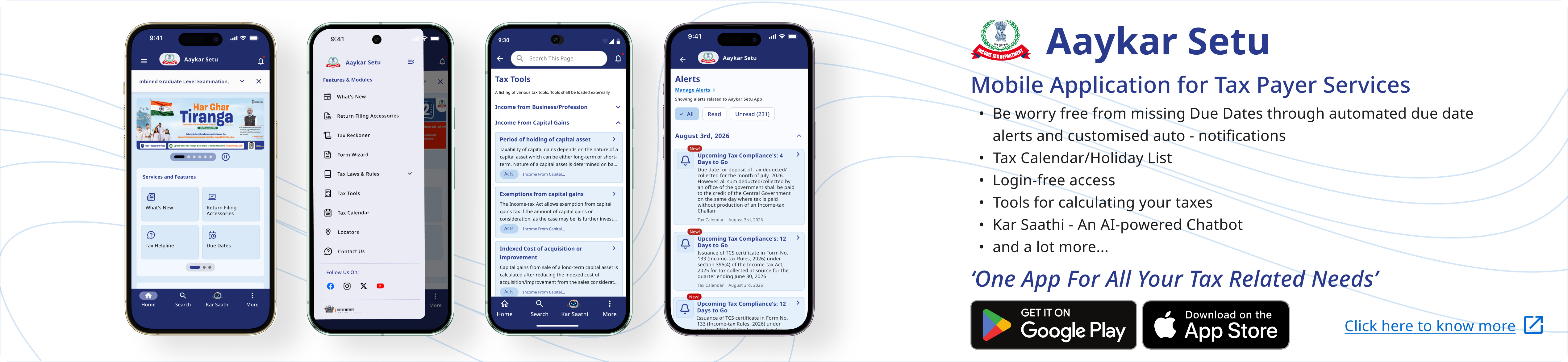](https://www.incometaxindia.gov.in/documents/d/guest/aaykar-setu) [](https://www.incometaxindia.gov.in/documents/d/guest/aaykar-setu)